Virtual Power Meter: How Bike IQ Estimates Your Watts
Power is the gold standard of cycling performance data, but it required a $300 to $1,500 power meter. Bike IQ calculates your watts from first principles of physics, using the sensors already in your iPhone.
What Is a Virtual Power Meter?
A virtual power meter calculates watts from physics rather than measuring them directly with strain gauges in a crank or pedal. If you know speed, gradient, wind, system weight, and aerodynamics, the watts required are mathematically deterministic.
Early "virtual power" apps used crude speed-to-power lookup tables that ignored grade, wind, and aerodynamics entirely. The results were unreliable. Bike IQ accounts for every major variable.
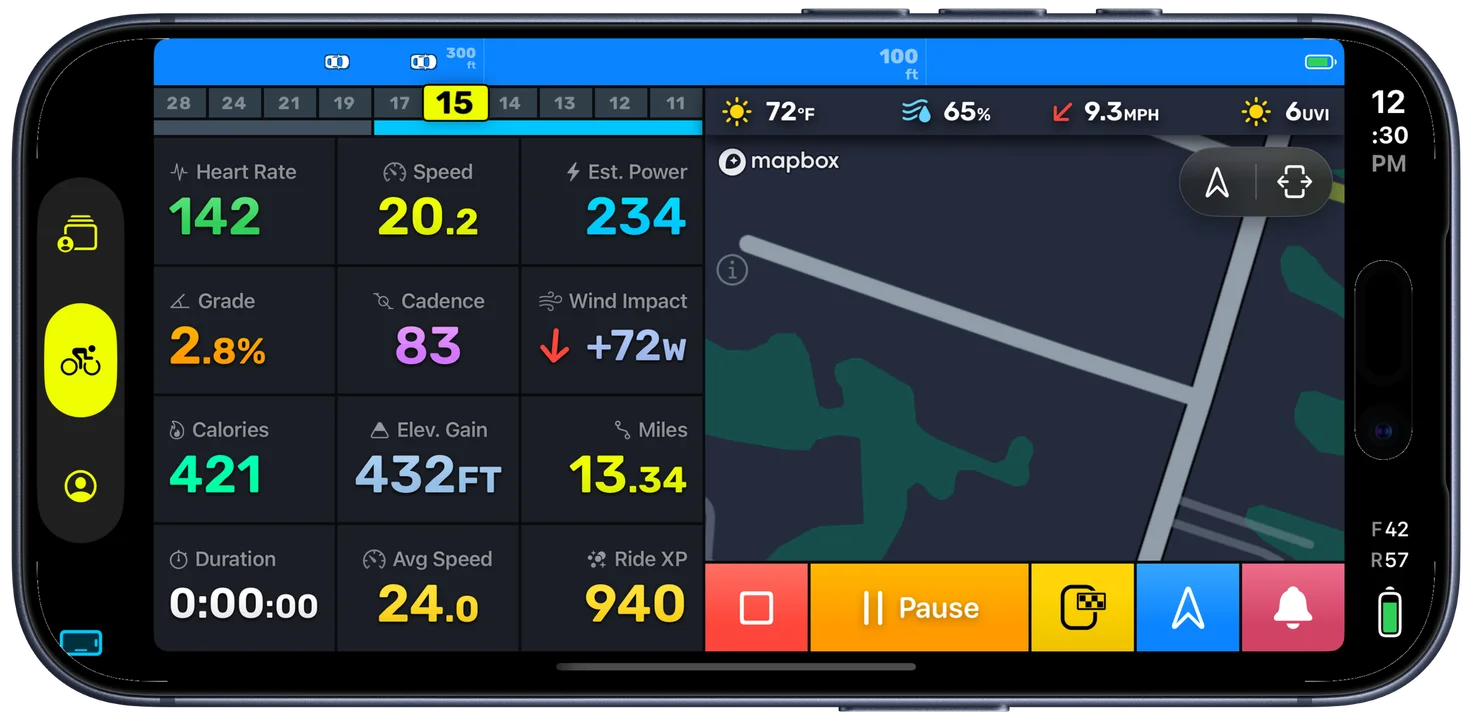
What Goes Into the Calculation
Bike IQ combines several real-time inputs to estimate power on every ride:
- Road gradient: measured continuously using the iPhone's built-in sensors
- Wind speed and direction: pulled from a live weather API at your current location
- Air density: calculated from altitude and conditions; thinner air at elevation means less drag and fewer watts for the same speed
- System weight: your body weight and bike weight, entered in your profile settings; the dominant factor on climbs
- Your aerodynamic and rolling resistance profile: seeded from your handlebar position and tire type, then refined over time from your actual ride data
How the Model Improves Over Time
Bike IQ's power model isn't static. The model learns from your rides, improving its understanding of your bike and riding style over time. Varied conditions (wind, hills, different speeds) give the model more signal to work with. Riders who pair a Bluetooth power meter provide direct ground-truth data, which accelerates the process significantly.
What Helps Calibration
- Varied terrain: hills and flats at different speeds let the model separate rolling resistance from aerodynamic drag
- Different wind conditions: calm days and windy days provide distinct aerodynamic signals
- Consistent rider position: the model assumes a consistent riding position for each handlebar setting (hoods, drops, aero). If you change positions frequently within a ride, estimates for that ride will be noisier
- Accurate weight: body weight is the dominant factor on climbs. A 2-3 kg error shifts climb power estimates noticeably
Calories from Power
Bike IQ calculates calories burned from your power output using metabolic efficiency estimates. When power data is available (virtual or from a sensor), calorie accuracy is significantly better than heart-rate-only or duration-only methods because power directly measures mechanical work. The conversion accounts for human metabolic efficiency (roughly 20-25%), meaning for every kilojoule of mechanical work, you burn approximately 4-5 kilojoules of metabolic energy.
Accuracy: What to Expect
Accuracy improves with the length of the window you average over. A 5 second sprint or a sudden acceleration is mostly noise; a 15 minute climb is mostly physics. Validated against Quarq and Favero power meters, average error runs about 12% over 30 second windows, about 10% over 5 minutes and about 8% over 15 minutes, with mean bias within a few watts of zero. The full method and the validation set are in the power whitepaper.
Two things are worth saying plainly about that comparison. Hardware power meters are not perfect references either, typically specified at plus or minus 1.5 to 2%, and crank-based and pedal-based meters can read a few percent apart on the same ride for sound mechanical reasons. And Bike IQ's estimate is smoother than a meter's, because it never sees the per-pedal-stroke variation a meter measures directly. For training that smoothing is usually a feature, but in a head-to-head it shows up as extra disagreement at the shortest windows.
On very windy or gusty days, expect wider error margins. Wind changes second to second in ways that are difficult to measure precisely from a phone, so instantaneous power readings will be noisier than on calm days. Averages over several minutes still converge well, but if you are riding in a strong crosswind or through gusty conditions, treat the moment-to-moment watts as approximate. See How Wind Affects Virtual Power for more on how Bike IQ handles wind in its calculations.
Short-interval readings carry real-world noise: gusts, bursts, sudden gradient changes. Over longer windows that noise averages out while the physics underneath stays right, which is why the error shrinks with the window rather than with the effort. Fifteen minutes is the longest window the validation measured, which is where the 8% comes from. The line is drawn flat beyond that rather than measured.
Who Is This For?
- Everyday cyclists who want to understand their effort, track fitness over time, and see power trends across weeks and months, without buying dedicated hardware
- Riders exploring structured training who want to work with power zones and ride comparisons before committing to equipment
- Minimalists who don't want another device on their bars
- Cyclists with a power meter who want software that learns from their data and improves over time
FAQ
Is virtual power good enough to train with?
For everyday cyclists, yes. Tracking power trends over time, pacing climbs, setting training zones, and comparing efforts on the same route are all solid use cases. Where Bike IQ's virtual power isn't the right tool: precision 1 to 5 second intervals, sprint analysis, or race-day efforts where a single watt matters. For that level of resolution, a strain-gauge power meter is the right call. For the vast majority of cyclists riding for fitness, improvement, and the love of it, virtual power is a meaningful step up from riding blind.
Does it work without any Bluetooth sensors?
Yes. Zero external sensors required. Power is estimated from the iPhone's built-in GPS, barometer, and motion data plus weather data. Cadence is also detected without a sensor. Pairing Bluetooth sensors (power meter, HRM, cadence, speed) adds data and can improve calibration, but isn't required.
Can I use it alongside my existing power meter?
Yes. When a Bluetooth power meter is connected, Bike IQ uses it as ground truth to improve its model faster. You get accurate real-time hardware data plus a system that keeps learning.
How do I get started?
Getting Started Guide: enter your weight and bike configuration, and the virtual power meter works from ride one. Or learn about using your iPhone as a full cycling computer.